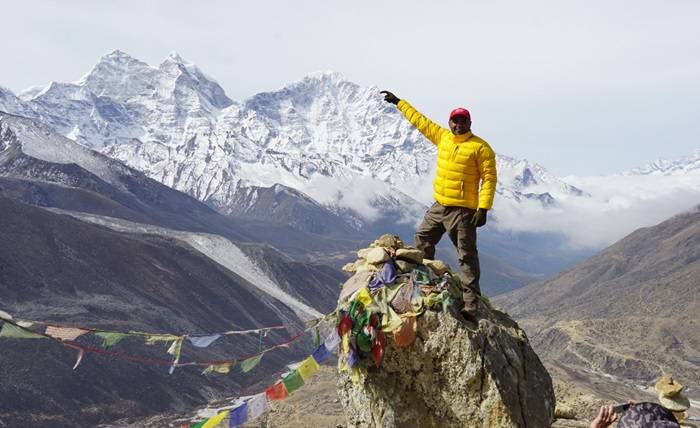
Everest Base Camp (EBC) Trek is one of the most fascinating and popular destinations in Nepal.
The EBC trek reveals us with four mountains, above 8000m, Mount Everest (8,848 m/29,035 ft) serving as the center of attraction of this bewitching destination.
Everest Base Camp trek is famous for its awe-inspiring mountain terrains, spectacular view of landscapes, and unique Sherpa culture, unlike vegetation and majestic animals lurking around.
In this ultimate guide, we will shower you with all the significant information and indispensable details you require to make your Everest Base Camp Trek a successful and memorable experience.
Brief Everest Base Camp Trek Outline
One of the most breathtaking and frequently visited trekking destinations in Nepal is the Everest Base Camp trek.
Withstanding still, in between ever-changing weather and majestic mountains, which are nestled at an altitude of 5,364 m/ 17,598 ft, this trekking offers trekkers elevated and sublime luxury experiences of the Himalayas.
The EBC trek offers a lifetime experience to trekkers, insight into unique sherpa culture, an alluring lifestyle, beautiful villages, glaciers, and a wide panoramic view of Mountains, Monasteries, enchanting flora and fauna.
Luxury Experience and Elevational Triumph in the Everest Base Camp Trek
Just above Everest Base Camp (EBC), you can aim towards Kala Pathhar (5,545m/18,192 ft) to witness a close panoramic view of:
- 4 mountains (Mount Everest, the Highest Mountain in the World”, Lhotse, Makalu, and Cho Oyu above 8000m.
- 2 mountains (Mount Pumori, and Nuptse) above 7000m
- 2 mountains (Mount Ama Dablam, “Queen of Mountains”, and Thamserku) above 6000m.
Moreover, you embark on your trekking journey on the trails of Sagarmatha National Park which is a UNESCO-listed World Heritage Site, along with the succulent experience of a lifetime.
Along with the majestic view, you could witness flora in the lower alpine region enriched with rhododendron, oak, blue pine, and wild roses, and fauna that includes rare mammal species like musk deer, red panda, Himalayan black bear, and if fortunate enough insight to majestic snow leopard.
In the trekking voyage, you have the chance to witness many captivating hills, lakes, glaciers, streams, beautiful places, and panoramic mountain views.
The Sherpa villages mainly exceptional Namche Bazaar (3,438 m/ 11,280 ft) – also the gateway to the Everest Base Camp (EBC) trek, accompanied by Tengboche Monastery, the biggest Monastery in Khumbu
Trekking Routes
As awe-inspiring as trekking towards an altitude of 5364m sounds, it is more thrilling at the beginning, starting the voyage from Lukla Airport (2,846 m/9,337 ft), which is the world’s most dangerous airport in the world.
You can also start your journey traveling through Kathmandu to Phaplu Airport (2,413m/7,916 ft), to experience distinct vegetation, diverse scenery, and unique culture, along with a venturesome journey.
However, if you are more of an adventure lover, a daring wanderer, have enough time, and like to visit through land routes then there are other alternatives.
You can easily hire a Jeep either from Kathmandu to Panggom, an elevation of 2,946 m/9,698 ft, or from Kathmandu via Kharikhola to Paiyan, nestled at an altitude of 2,830 m/ 9,284 ft.
One can start their journey from around an elevation of 2,400 m/ 7,874 ft up to Kala Pathhar, nestled at an altitude of 5,545m/18,192 ft.
Distance and Duration
The trek duration is usually about 12-14 days or could be escalated to an 18-21 days’ timeframe.
The Khumbu region presents with Everest Base Camp trek, three passes, peak climbing, and an expedition; an epic sightseeing and unforgettable experience.
All the trekking routes start and end at the Lukla, covering a distance of 51 kilometers (32 miles), and an overall round trip of 102 kilometers (64 miles).
Accommodation and Services
Most of your trekking packages will include all the accommodations along with Breakfast, Lunch, and Dinner (BLD) services.
You will spend your night mostly in guest houses or tea houses, as the elevation increases the service reduces.
Other amenities like flush toilets, and hot shower facilities are also available during the stay nevertheless once you cross Namche Bazaar, it will be a challenge to your perseverance and willingness to complete the trekking.
Insurance, Permits, and Deposits for the Everest Base Camp
All the trekking destinations in Nepal need certain permits to visit, most of your permits are handled by your tour operators.
However, if you are a Free Individual Traveler (FIT) the Everest Base Camp trek demands a Khumbu Rural Municipality permit and a Sagarmatha National Park permit.
You can acquire your travel insurance before coming or after visiting Nepal.
There are other charges such as guide insurance and garbage deposit fare that you need to remunerate if you are enthusiastic about climbing peaks and expeditions.
Difficulty Level and Fitness Required for Successful Trek
Everest Best Camp trek elevates at an altitude of 5364m, though if we keep ascending to a higher altitude level, the surrounding air keeps getting thinner.
The difficulty level of the trek is quite moderate, one can easily trek to the base camp with careful breathing and slow pacing, walking between 5-8 hours every day.
Therefore, you might always be ready to face consequences like mild headaches, altitude sickness, unable to eat food, and other gastronomical consequences.
Before you start the trek, you must prepare to improve your stamina, doing cardiovascular activities, and breathing techniques, ensure your health and fitness, and learn safety tips that would prove quite fruitful in the trekking.
Seasonality and Best Time to Trek in the Everest Base Camp
Every season offers a warm welcome and the possibility to embark on a natural beautiful journey.
The trails change from a dense lush evergreen structure to a thin barren deciduous composition.
The best time to trek Everest Base Camp is in Spring and Autumn season. The weather breakdown can be studied as:
-
- March to May – Spring Season – Peak Season, busy and occupied route, trending for Everest and Peak Summit.
- June to August – Monsoon – Off-season, trails are not quite crowded.
- September to October- Autumn- Clear and stable weather, mostly crowded.
- November to January- Winter- Cold and snowy weather, difficult to trek, risky.
Important Clothing and Additional Accessories
The first and foremost thing you need while trekking around Everest Base Camp trek is knowledge about the surroundings, endurance, and the tendency to challenge its beautiful yet, unforgiving harsh weather.
Consequently, you will need protective clothes, breathable gear, equipment, and accessories to withstand its despicable environment.
Some of the gears and accessories could be:
- 2 pairs of rips-off pants, changeable to shorts
- 2 long sleeve breathable dry shirts
- 1 polar fleece pants and sweater
- 1 pair thermal Lycra long sleeve and pants
- 1 breathable sweatshirt
- 6 pairs of North Face Thermal Socks
- 5-6 pairs of breathable dry underwear
- 1 waterproof down Jacket
- Cap
- Winter thermal Cap
- Beanie
- Gloves
- Neck Gaiters
- 50L-60L Bag
- Headlamp
- Hat
- Sunblock
- Moisturizing Cream
- Watch
- Sunglasses
- Insta 360
- Camera gear and electronics
- Water Bottle
- Power bank
- Extra Battery
Basic Short Simplified Itinerary for the EBC Trek
Life in the mountains is thrilling and beautiful, harsh and joyful, painful and ecstatic. However, it also demands us to become more enriching, and adventurous.
Here is the short and simplified itinerary of the EBC Trek:
Day 01: Arrival in Kathmandu (1,350m/4,429 ft), Transfer to hotel.
Day 02: Fly to Lukla Airport(35-40mins) and trek to Phakding (2,800 m/9,187 ft), around 4-5hours. Overnight at Guesthouse.
Day 03: Trek to Namche Bazaar (3,438 m/11,280 ft), around 5-6 hours, Overnight at Guesthouse.
Day 04: Acclimatization Day @ Namche Bazaar- the gateway to EBC, Sightseeing.
Day 05: Trek to Tengboche (3,870 m/12,697 ft), around 5-6hrs, walk, Overnight at Teahouse.
Day 06: Trek to Dingboche (4,360 m/14,305 ft), around 5-6hrs, walk, Overnight at Teahouse.
Day 07: Trek to Lobuche (4,940 m/16,208 ft), around 5 hrs walk, Overnight at Teahouse.
Day 08: Trek to Everest Base Camp (5,364 m/17,598ft) via Ghorak Sherp(5,190 m/ 17,027 ft), around 7-8hrs, walk, overnight at Gorak Sherp Teahouse.
Day 09: Early morning trek to Kala Pathhar (5,545 m/18,193 ft), descend to Pheriche(4,240 m/ 13,940ft), around 7-8hrs walk, Overnight at Teahouse.
Day 10: Descend, trek to Tengboche (3,870 m/12,697 ft), around 5hrs walk, Overnight at Teahouse.
Day 11: Trek to Namche Bazaar (3,438 m/11,280 ft), around 5hrs walk, Overnight at Guesthouse
Day 12: Trek back to Lukla (2,800 m/ 9,187 ft), around 7 hours walk, Overnight at Guesthouse.
Day 13: Flight back to Kathmandu via Lukla Airport(35-40mins), transfer to hotel.
Day 14: Token of love, bid farewell, enroute to the TIA Airport, final departure.
Conclusion
Everest Base Camp trek is one of the perceptional changing treks that surmises thousands of people’s stories, has changed lives, impacted, touched, and healed thousands of people’s life stories.
Mountains have always put people’s comfort, way of life, and mentality to the test. Thousands of tourists visit EBC each year, and as this crowd increases each year, the responsibility to sustain this destination for a long time also escalates.
If you are striving to outgrow your comfort zone, Everest Base Camp trekking will help you challenge your endurance, introduce you to uniquely aesthetic culture, and push you toward a higher level.
Why not experience the responsible and awe-inspiring journey of a lifetime? Why not embark on a challenging yet beautiful journey?
Leave a Reply